The Loyalty Store.

0

One of the 24 Questions I use in my deep dive brand planning rigor is “How much company revenue comes from existing or repeat customers?” When I compare this figure with lost customer and new customer revenue I get a sense of a company’s loyalty, loss and business development focus.

If you look at marketing job boards today you will notice a great deal of acquisition activity.  The majority of marketers are absolutely smitten by new customers; it’s akin to generals in battle who need to take new territory. Loyalty marketers, on the other hand, know it is the back door, the door customers leave by, that is most critical. 

chocolates

Loyalty is engendered when customers are not overlooked. Everyone knows a broken family where mommy or daddy found s new partner because back at home they felt underappreciated. This behavior not only breaks up families, it drives wedges between parents and children. Loyalty, love, under-appreciation and inquisitiveness are human traits. Marketers try to build love through the AIDA principle: Awareness, Interest, Desire and Action, often forgetting Loyalty until it’s too late. Until the back door has been open too long.

Coupons (sorry honey flowers), shallow thank yous, and automated responses do not loyalty make. Understanding yourself and your customers through a well-principled brand plan, is the place to start. Otherwise, it’s off to the loyalty store for some quick fix tactics.  Peace.
 

Cull the Follow Herd.

0

I’m a big Lindsey Vonn fan.  It borders on creepy but not creepy enough to visit her Facebook page. Yesterday, Lindsey announced she pulled out of the Sochi games.  I learned about it on Twitter. She in in my Facebook feed, I think, but doesn’t show up so much as she’s kind of busy.

As an adult and marketer, I have started to coalesce my thoughts on social networks. Readers know I’ve long said Facebook is for friends and school peepsLinkedIn is for people with whom I have done business (ish)Twitter is for all of the above plus likeminds and admirees.  Twitter is where I share my total persona. Some politics. Some personal philosophy.  Some troll-able business scat (not the dung).  It is where I hope to learn from others, often those unknown. Twitter is my most expansive social network.  

Facebook is only as good as the shares — and sharing is magnified based on how close you are to the person. I’m not going Gaga over a 7th grade crush showing pictures of her kids in Clearwater (Facebook). Your feed is watered down if it has too many uninteresting posts. Burger King is offering $4.00 duck burgers. That said, I really don’t cull the “follow herd” and that’s an issue for Facebook.  Too much noise in the feed.

What to do about it.

Remove unwanted friends, peripheral people and brands from your Facebook community.  You can always add them back.  You can always find the brand if you need it. Play LinkedIn by the book and only connect with those you have done business with. The rest is spam.  And fly like a birdie on Twitter. Note to Twitter: don’t extend beyond 140 characters.  Where does this leave marketers? Better off. With more traffic to their own sites and ads that are more powerful because they are ads – not friends. Peace.


Selling a Brand Plan…Lessons from Christie’s.

0

So I’m reading this NY Times Sunday Magazine interview of Christie’s auctioneer Jussi Pylkkanen and the question is posed “From the outset, how do you identify the right bidders in the room?” Says Jussi “It’s the glint in their eye, and intuition. It’s about the posture of the client, how they sit forward on the chair, how they make eye contact with you. As I look up, I know the four or five people that are definitely going to bid.”

Cool skill? Yah huh!

If I apply this level of observation to my business, will it tell me who in the room is going to buy brand strategy? Moreover, will it tell me who in the room will actually implement it — an equally important question.  When you think about it, someone willing to pay hundreds of thousands, even millions, for a painting has to be on the edge of their chair. As does someone buying into a brand strategy.  When I look into the eyes of C-level executives while presenting and see the fire, see the wheels turning, I know I have them. It’s the kind of engagement Jussi sees. When I see that glint, I know who the buyer is. Don’t underestimate playing to the buyer. The outliers in the room will see it and catch on.  

If there is no response, no emotion, no visible cognition, it’s time to cue the orchestra. Peace.

Viva la diff

0

One of my mantras is “provide every company employee with an understanding of the brand strategy.” A brand strategy being the organizing principle that drives value. Bank account value. Which is fed by perceived consumer value. When employees know the brand strategy, the good ones pursue it, use it and think about it — even on weekends.

At Zude, a start-up I was a part of in the web space, the brand strategy was “the fastest, easier way to build and manage a website.”  The CFO of Zude Jeff Finkle used to say that every employee walking to their car at night should ask his or herself “What did I do today to make Zude a faster, easier way to build and manage a website?”

When Larry Page took over from Eric Schmidt as CEO of Google, he declared this as a company mission: “To get Google to be a big company that has the nimbleness and soul and passion and seed of a start-up.”  Not a brand strategy.  It’s an operating or operations strategy. Certainly it’s laudable and good business. Certainly employees can ask themselves as they leave the building if they passed the litmus. But it’s inward focused and brand strat needs to be outward focused.  Beware the difference. Peace.

Business Consulting or Brand Consulting?

0

Bob’s Discount Furniture just received a cash infusion from Bain Capital. In other words, Bain now owns a big chunk of the company. If you were Bob, or any other  underperforming company looking to fix their business what would you do?  Before you sold out to a big fixer company like Bain, that is? Many go the root of hiring big business consulting companies such as McKinsey, Boston Consulting or Booz. Pricey choices. Especially for a company under duress. You certainly wouldn’t hire a brand consultant.

But should you?

If you were to go to Landor, Interbrand, Wolff Olins or Siegel+Gale, you’d get some really smart people supervising your business, a lot of smart designers and brand planner worker bees, resulting in a new logo, style book, positioning statement, some lessons in voice and, maybe, if they were feeling a bit feisty culture. Probably not going to fix the business.

Were you to come to What’s the Idea?, a different kind of brand consultancy, you would get some of these things, but only after signing onto a brand plan — the foundation of which is built upon business metrics.  Business fundies. Economic success measures.

A brand plan built upon anything else is simply storytelling. (And storytelling is the pop marketing object of the day.)  Am I suggesting an engagement with What’s The Idea? is superior to a big city business consultancy or brand consultancy?  Perhaps I am. As someone schooled in both disciplines, who works within the company to determine issues and answers, this approach is a “heal thyself” approach. It’s a learning model rather than a teaching model. Peace.


Twitchable Moments.

0

I wrote earlier in the week about ad tracking application iSpot and how it will help marketers with Twitch Point Planning. Twitch Point Planning being a new transmedia planning tool that takes advantage of the twitchy behaviors consumers exhibit in today’s device-friendly, social media world.

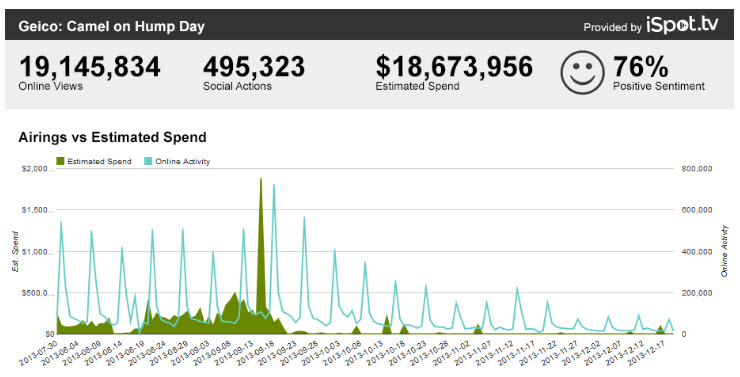
Here’s an example of a twitch the Geico Insurance and The Martin Agency may or may not have designed into the famous Hump Day TV spots.  Lots of people like the Hump Day spots — the boisterous, roaming camel asking “Guess what day it is?”  This spot from the campaign has over 19M views on YouTube.  Do you know what day these spots are shared the most?  Wednesday.

ispot

Do consumers buy more Geico insurance on Wednesday? Maybe a bit more because the brand is top-of-mind, but my guess is this effort was not that strategic. Not strategic like Wednesday is Prince Spaghetti Day or BOGO (buy one get one) on a restaurant’s slowest day of the week.

The metrics, however, do show twitching behavior can be manipulated. And that’s the key learning. Find an on-brand idea that gets shared on a particular day of the week, and you have a new tool in the social arsenal. There are lots of twitchable opportunities for brands – they just have to have a goal and think like consumers. Peace!


iSpot is Tres Cool.

0

iSpot is a new ad tracking platform that marries TV spot appearances and spending with an overlay of online sharing activity.  It’s a brilliant idea. (Oh, happy New Year’s Eve, by the way.) During my time at McCann while spending big bucks on TV advertising for AT&T, the tracking people always paired weekly spend with the revenue it generated. I always marveled at how the revenue lagged the spend by a week or two. This lag was the case for most consumer packaged goods. It’s interesting to note that according to iSpot there’s a similar lag in social sharing of TV spots.  Most shares of the Geico “Hump Day” and Samsung Galaxy Gear spots were not on the night of the ads, but a few days after. Check out the metrics.

My problem with social, and I know it works trust me, is that what we are often measuring is divorced from sales.  Clicks. Likes. Shares. Views.  iSpot’s new platform provides data feed that should plug in nicely to sales reports. Como se holy grail?

Readers of Whats The Idea? know about Twitch Point Planning — a twitch being a media moment when one engages a separate device for additional information, learning or sharing.  iSpot is a platform with a chance to make Twitch Point Planning a prime time tool. And vice versa. Stay tuned in 2014.

Peace be upon you.  

Big Plans for ExxonMobil?

0

ExxonMobil was once the world’s largest grossing company.  It’s still way up there. In early 2012 they started running K-12 education advertising.  A cause marketing effort. The ads were pushing STEM (science, technology, engineering and math), which one might explain as a recruitment effort as ExxonMobil was looking toward the future — reinventing the energy business. But I think is was more post BP Gulf oil spill driven — an attempt to deflect negative oil company press. (I was working in the education space at the time and paying attention.)

Frankly, I’m not sure what ExxonMobil is doing with their advertising these days but at least some of the latest ads involve energy, or what I call an “endemic category message.”  The new ads promote an energy quiz and use the line “Energy Lives Here.”  They have a really smart planner at BBDO working on the business (or they did as of a couple months ago) so I wonder what the problem is?  BP’s licking its wounds and rear-view mirror planning; that’s to be expected.  But ExxonMobil?  Just not sure. They have a good agency and plenty of money so I expect they’ll find their way at some point. Peace.    


The Svelte Apple?

0

As big as the Chinese mobile phone market is, I’m not sure Apple should be pursing its current growth plan there.  And last year Apple sold 23 million phones in China. The price of an Apple mobile in China is in the US$700 area. The price of a locally produced Android based phone US$100.

In my view Apple should attack the Chinese market with a local start-up.  Don’t dumb down and feature down the 5Cs and 5Ss, to get the price margin better.  Leave them as they are, priced as luxury phones for the up market consumer. Start a new company to fight more fairly the Chinese manufacturers Lenovo and Huawei and South Korean behemoth Samsung.

Keep your R&D eye on the ball in America, the ball being other internet connected devices. We forget that Apple, when not bothered by business blocking and tackling (and shareholding-focused share gain), has a history of inventing new categories.  I fear that with all this energy focused on selling iPhones in China, Apple will regress in the ROW (rest of world) and start to slide.

Small share in PCs gave birth to the Apple of today. Stay the course. Innovate the form, the features and the software. Technological obesity in unbecoming. Especially for the svelte Apple. Peace.

Fight the Machine.

0

verisimo

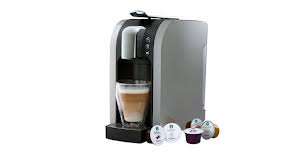
Starbucks executives, always on the lookout for ways to make more money (as they should be), have, until now, sat idly watching the growth of Nespresso and Keurig. Home and office brewing of coffee in single servings it is a hot category.  A category that follows the razor blade theory…discount the device, make money on the replenishments.

Starbucks see this single brew trend as not going away and recognizes coffee bought in pods is not coffee bought at their retail stores. Sooo, they’ve decided to sell a coffee maker. In other words, they are betting against themselves and accelerating the single serve brew category.

Stop it!  This is not a line extension, it’s a cannibalization. It diminishes the mission of the brand. These machines are the enemy.  The afternoon Starbucks run, the mocha, choca, locca $6.50 morning drink, the aroma of the coffee beans and din of the cool music gone. Fight it. Go all Davy Crockett on its ass. Davy may be dead but he’s alive in our hearts and minds and he defended and reshaped a country.

Starbucks is part of the craft economy. Convenience be damned.  Starbucks needs to stand up and fight! Fight the machine. Peace this holiday season.