Dumbed Down Utility.

0

Today The New York Times had a cover story on geolocation dating services. If you’re looking for a date and have a smart phone these new apps tell you who is nearby and available. Text, text, plan, plan and you can grab a drink with little social awkwardness. The services are Grindr, Bendr, OKCupid Locals, and How About We.

I was a doofus at bars as a young ‘un and couldn’t walk up to interesting girls with a good rap. For someone in the selling business it was a skill I needed to work on. Had I an app for that, would I have learned the skill faster? 

Here’s my take, socially inept kids hide in their cell phones. Heads down, active in the ether, they appear to be busy. Some kids feign being on the phone to look popular so they can troll for interaction, they hope will come their way. Not good. Unless these are kids who might never make it out of the house to begin with. I suspect that these geolocation apps will soon come with “sorry” buttons so users don’t have to deal with ending these pseudo dates.  Rather than look someone in the eye and say “Thanks for meeting with me but…” the daters will simply hit sorry and the app will ping the date is over. (I can just hear these unique ping tones, ringing across the bars of NYC in 2012.)  The human behaviorists and sociologists are going to have a field day with this stuff.

We need to move beyond a dumbed down utility with apps and think about skill enablement and development. Peace is not an app. (Or is it?)

Credit Card Advertising.

0

McCann-Erickson’s “Priceless” campaign for MasterCard is arguably one of the most respected credit card campaigns to come along in decades.  “It’s everywhere you want it to be” was a great ubiquity campaign for Visa, but that’s long gone.  The problem with advertising is that sometime the advertising becomes more important that the product.  Priceless is an example of an advertising idea that overshadows the card.  Emotional attachment to a brand is important in terms of tone — and that’s what the campaign does so well.  But it is an advertising dimension. Products that tie their horse to an emotion (Coke are you listening?) rather than product benefit or quality are using advertising to get attention.  Or remind us to pay attention.

MasterCard, has done some very cool innovative things like PayPass and smartphone apps yet is sadly still famous for its priceless advertising. No matter how much it tries to make PayPass priceless, the ads are still about a smiling kid in a baseball hat.

Today MasterCard’s tagline is “That’s MasterCard. That’s Priceless.”  The “That’s Mastercard” portion takes a register mark so it looks as if they are beginning to think about evolving away from Priceless and straddle two ideas.  But “That’s MasterCard” smells like an empty vessel. This is a tough category, but for far too long it has been managed by ad people not marketers. It’s time for that to change.  Peace.  

Is it not true that the opposite of promotion is…

0

Have you ever noticed that law firm earnings rarely make the papers?  Or that gazillion dollar law firm names are unknown by the masses? We really never think about big corporate law firms. As Occupy Wall Street targets the banks and focuses on corporations that do not pay their fair share taxes, lawyers walk back and forth with nary a glance. 

A friend of mine is in operations at a law firm in NYC and very involved in build-outs and office relocations. His firm is in a semi-historic NYC building and they are renovating like a dookie. Conference rooms like museums, two-story, south-facing offices that would make a king blush.  Corporate and high-end law firms are the subject of good TV drama, but fly under the radar because they are private and in the business of stealth and secreting information. They are also in the business of reverse brand management.

Staying out of the public’s eye and keeping clients invisible is an art — and lawyers do it best.  Perhaps some large communications companies who build reputations for a living should hire and study top law partners to understand the enemy.  The enemy being the opposite of promotion. Perhaps then we can invent a few new ways to sell.  Peace.

YouTube. Health Info On-Demand.

0

 One of the fastest growing content areas on YouTube (data source: me) is healthcare channels. Hospitals and health systems are uploading talking head videos at an amazing rate. One large nationally recognized hospital recently uploaded 25 videos by lunchtime.  YouTube has a way to go in perfecting its channel tools but visitors can search by clinical area, date added, most viewed, and top rated.

Healthcare provider companies are not known for their marketing expertise — they are too busy saving lives — but the move into YouTube is a smart one.  Do you know anyone who doesn’t have a family member with a health problem? The quality of these videos is quite good, albeit a bit over-polished.  If you remove the occasional singing video encouraging employees to wash their hands, you’re left with a body of work where humans talk to humans in understandable English, removing the magic.

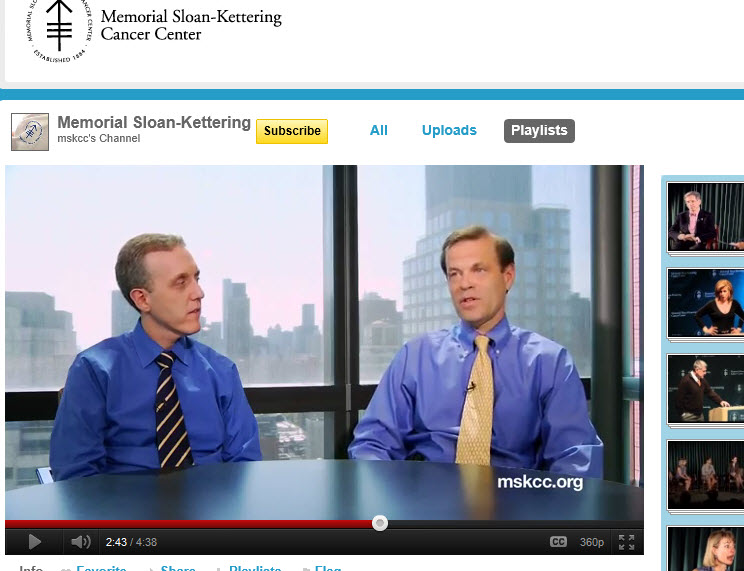
Personally, I find the videos that don’t feel too scripted the best. Two docs at Memorial Sloan Kettering were talking on camera, sans make-up, and it felt very different from the norm, very real. The hospital has a reputation for clinical coolness and this video worked to change my attitude.

The ROI problems is this — these videos cost a good deal of money to produce and some get 28 views while others get 28,000 views.  As these channels grow in search sophistication and the video producers evolve, we are going to see some serious, serious advances traffic. This is big, important business. Peace! 

Brand Promises and Stereotypes.

0

Stereotypes are important in marketing because they are patterns.  Many feel that if you play to the patterns, you will win.  Creative directors, on the other hand, have made a living going the other way — staying away from patterns, which is a pattern in itself.

Stereotyping Angela Merkel, Chancellor of Germany, might suggest she was more likely to assist in the EU bailout because she’s a woman – a mom.  Stereotyping a Long Island Rail Road worker who took retirement with disability at age 50, might portray him as a golf-playing aerobicist, while the reality is he is an arthritic thanks to 30 years keeping the trains moving during winter snowstorms.

Is someone in Aspen, CO who opens a retailer door and shouts in “Which way to Little Nells?” a New Yorker?   Okay, that one might be accurate – but the reality is stereotypes are nothing more than learning for a brand planner. And as planners if we know “no one wants to be a stereotype.”  It doesn’t mean the consumer wants to be the pioneer who takes the arrows  or the Beta User whose machine gets crapped – it just means when being sold, we want to feel individualized.  The promise has to have promise…not an explicit benefit.  Let consumers’ minds work and process things in their own way. Europeans are better at this type of selling than Americans.  In the U.S. we are very explicit with our ads and social media.

Sometimes being broad with a promise works harder.  Peace.  

BlitzLocal and brand planning.

0

Dennis Yu CEO of BlitzLocal is a smart dude.  He did a presentation about BlitzLocal, Facebook, data, and marketing futures last night at Hofstra University and it was eye opening. (What is Hofstra’s brand idea, by the way? Something with a right pointing arrow?) Anyway, a number of cottage industries have popped up over the years to help people market on Facebook and BlitzLocal is a good one. As is Involver.

Sitting through the preso I was wondering what kind of company BlitzLocal was — never having heard of them. My take?  It’s an analytics company.  The BlitzLocal Is-Does?  A Facebook analytics company (Is) that implements and optimizes Facebook marketing programs (Does). 

Mr. Yu started the evening with some really heady talk about brand building and how promotional giveaways  are a blight, then he segued into data capture, tools, and the raw power of the Facebook platform.  As an admin on a brand account, he playfully posted an offer to see how many people wanted a free pair of jeans and in minutes had 4,000 hits.

So how does this type of real time analytics stuff rub a brand planner like me – someone in search of the big positioning ideas and planks that and drive long term value?  Well, I’m a believer and will add these tools to my arsenal.  I rail about tactics-palooza, but the insights derived from a BlitzLocal engagement are too important to cast off. This kind of data, especially at the high order level, needs to go into the boil down. One more important loci for the plan. Right brain, left brain. Yin and Tang stuff.  Can’t wait to play. Peace.

IBM’s Unclean Idea.

0

Ogilvy is a great advertising agency.  Always has been.  It loves big ideas, big productions and big brands.  Lately, it has made a name for itself on services companies.  Other than American Express and IBM, I’m not quite sure what accounts they have – which is my bad, but partly theirs. 

IBM’s “Solutions for a smarter planet” was a big idea. Already well entrenched with big businesses on the hardware, software and services (consulting) side, IBM decided that rather than grow by increments, it would focus on large-scale advances targeting countries and industries.  That’s some enchilada stuff, there.  “Solutions for a smarter planet” helped IBM take on the planets ills (traffic, energy, food) and showcase some future technology.  By going big, it covered small (corporate) and positioned IBM as vendor of choice for massive overhauls.

Then the economy tanked. And companies started having a difficult time making payroll. And saving the planet lost a bit of luster.  Rather than returning to an advertising idea that supported product and services sales, IBM tasked Ogilvy with keeping revenue up by evolving the idea — the planet will be back at some point (knock wood).  Enter “I’m an IBMer, I’m an IBMer.” For the purposes of continuity (agencies are big on that) the campaign is tagged with “solutions” but focuses on smart employees.  Mistake.  It milks a campaign idea that is no longer the business idea.  Like the Microsoft Bing work that straddled two ideas “information overload” and “decision engine,” IBM is pushing an unclean idea.

Come on Ogilvy, bring on the new work – the new idea. Peace!

Some Assembly Required.

0

Biophilia is the name of a just released Bjork art project. An album available only on the iPad, this, by some accounts, is the first consumer controlled piece of music released to the world.  Though it will take some arrows and may not be a world class compilation of music, it’s what excites me about technology. One plus one does sometimes equal 3.

Much will be written about the new album, but one thing that is undeniable is it breaks new ground.

I recently worked on a project in the contemporary art world and Bjork’s project inspires me to wonder if consumer controlled paintings and mash-ups might be in our iPad or online future?  Any person who ever took an art class in college and created a painting knows it is not easy. Though, with the ability to copy and paste art elements from photos, online galleries and stock images together on a screen and create a print or canvases – that’s some cool.  No more pictures of cats next to fruit bowls in the dining room.

Consumer created content is part of the web’s DNA. Art appreciation is part of human DNA. New doors open every day and the doors that open to the art and music world are richer than most. Peace.

CEOs and Faulty Dashboards.

0

The thing about corporate leadership is you need to know what you are leading.  Sounds simple right?  If you think you are leading “people” or, worse, “employees” you are toast.  If you are leading “change” more toast.  Throw “turnarounds,”  “team” and “movements” in for good measure. The what you’re leading is the product and product result for which people are paying.  Airlines are in the long distance transportation business.  If they lose sight of that and someone creates a helicopter that gets passengers where they want faster and cheaper the airlines lose.

Only when a leader understand the what can s/he focus on the why — what the company trying to accomplish? Should the why be to make the most money possible, that’s not leadership because it lacks product endemic vision. To take the fast helicopter example further, the why might be tied to the fact that when flying on a plane today one spends more time preparing to fly than actually flying. The why might be to be the most efficient means of long distance transport.

With the what and the why answered a great leader can then govern the chess pieces toward the how – the strategy. Everyone wants to be strategic.  But strategy without plan, without reason is really just a tactic is disguise. A company with a leader who has a dashboard with forty gauges and knows them all, but can’t tell you the what and why gets a B- at best. Peace!

The New York Times Brand.

0

The New York Times, one of the top 5 brands in the world (IMHO), is beginning to get with the digital program. And the result? A profitable quarter.

I buy and read The New York Times every day.  When I think about it, what I pay for and what I use are way out of whack.  Let’s say there are 60,000 words in any one issue of which I may read 3,000.  What kind of usage is that?  Yet I’m as loyal as a house cat.  Why?  Because the NYT has managed its brand brilliantly. It offers the world — reported and depicted without bias (save for the editorial pages) in a wonderfully written and presented format.  The Times defines news journalism as Coke defines cola.

With the web collapsing the news cycles and citizens sharing pictures and video in real time, the Times has lost some of its news magnetism.  Until it gets it back.  It has been slow to adopt social media as a tool for tracking and reporting stories but is picking up speed. And once it catches up, it will lap citizen journalism. Someone from the Times could have been in position west of Surt, Lybia yesterday to get some original photography. Instead its photographer were in Surt.   

How the Times gathers, reports and analyses news and stories is changing, but the branded product they serve up remains the same. That culture, that brand, that product is so tight it will never Kodak (verb.)  It has been a bit bumpy, but watching the Times find its sea legs in the digital world is going to be very exciting. Peace!