
Health, Hain and Hereafter.

0

There’s a company here on Long Island named Hain Celestial.  Most know it for its line of teas. Today it is a consumer packaged goods company with wonderful focus. The result of wonderful leadership. The company sells many products in the natural and organic spaces. Space that are outperforming traditional food and drink by a full 10%.  Traditional (read not so good for you) food and beverages are growing 1%, while better for you are growing at 11%.

A spin-off of the craft economy is our attention to eating better.  Eating at home more, so as to better control foods that go into our bodies.  Less sodium. Less saturated fats. Less gov’t-subsidized high fructose corn syrup. Less genetically modified foods. It’s a movement, nee a spring.  A healthy food spring. (But God, I do love bacon.)

Hain Celestial is winning and spending and focusing on what a growing portion of the population wants. Better for you foods. As Irwin Simon, CEO of Hain said recently “Eating healthy is not a fad.”  

From a targeting point of view, those buying these products tend to be a little up market; able to afford the higher price point.  And this doesn’t bode well for lower income communities. Nutrition will and should be a building block of the Affordable Care Act. And of education reform.  And what grandmas pass down through the generations. Poor nutrition fuels the high cost of care in America.  

Keep an eye on Hain Celestial products.  This company will be the healthy P&G in a few years. Bank it. Peace.  
 

Robots and drones and bears, oh my!

0

Not to be outdone by Amazon’s drone delivery announcement on 60 Minutes Sunday Night, Google hit the front page of The New York Times today with a story trotting out Android czar Andy Rubin as head of its new robot division.  Not to be confused with Google’s self-driving cars business (Just what we need, more cars.)

And it’s not only a future thing, robots are arriving in schools daily, as my friends at Teq will tell you.  The NOA robot is setting kids a-giggle across a number of Long Island schools.  And robots are even cleaning windows now. Take that! window washers union of NY.  Drones and robots deliver on Larry Page’s vision, “Technology should be deployed wherever possible to free humans from drudgery and repetitive tasks.” Como se breathing?

Have you seen a movie trailer lately?  Or prime time TV show? They are 50% fantasy. Dude, I love technology. I also love the future…and that we’re becoming smart enough to know when we’re effing up the planet and gene pool. I love all the “springs” that are blooming…but let’s remember to take time to watch the bears (see headline); those pesky animals rolling around in our urban sprawl dumpsters.  Nature is still the best part of humanity. The craft economy or roots economy is part of that and is picking up speed. It will not outpace the robots and drones, but it’s growing.

Good marketers and brand planners see ahead of what’s trending. Peace.

Voice-Activated Branding.

0

It is a rarity in branding circles that you don’t hear references to “voice.”  A subset of voice is “tone and manner.”  Tone and manner are often found on creative briefs. They can be important so long as they, alone, are not carrying the brand directive. Voice or tone and manner often sound like this: “helpful and happy.” “caring and motherly,” or “innovative and direct.”  

Voice is a quality, not a strategy. A brand strategy is not built with tone, voice or personality – it is built upon a persuasive, business-winning, organizing principle (one claim, three support planks) — the components of which are both desired by consumers and well-delivered by the product.  When “what consumers want” is not well-delivered, that’s a problem. Not insurmountable, but it may curtail market share. It also may suggest segmentation opportunities. Not everyone likes anchovies.   

Voice is an adornment to a brand strategy. It can work well in support, but alone never carries the day. Peace!

An Economic War on Waste.

0

The composting plates being tested in schools cost about $.15 a piece to make. Seven times that of the $.02 plastic plate. These composting plates, made of sugar cane, require more time to manufacture and are more complicated than their stamped out plastic cousins. It’s the future, before our eyes. What savings might accrue to a sugar cane plate vs. plastic? In most cases both will still have to be carted, but putting nutrients back into the soil will produce saving.

What is the cost of moving from antibiotic-laced chickens in our diets to organic chickens? Cents a pound? Dollars a pound? Sure.  But the back end savings of that move? Rather than having to undergo 3 different, escalated courses of drugs to knock out bronchitis, perhaps only one? Do the math.

And lastly, if a country like Mexico taxes sugar laden soda and fast food, will it begin to lose its mantle of the world’s obesity king? And will healthcare costs in Mexico reduce by billions? You know the answer.

This is not stuff of the craft economy, though craft economy acolytes are certainly supporters of a more sustainable bio-planetary model, these are simply healthy choices which at face-value don’t make economic sense. We are moving in this direction in America, slowly.  This is our awakening. Marketers who pursue this new direction – companies like Hains Celestial – will slowly win this war.  A war on waste. An economic war. Peace.      

Revenue is Kinger.

0

HP’s earnings were higher than expected this quarter, but revenue was down. Contemporaneously, Silicon Valley is celebrating the smartest kids in business  (I don’t know their names) owners of Snapchat who just turned down $3B from Facebook — and they have no revenue model.

For all the expense cutting Meg Whitman has done at HP — for all the business blocking and tackling — it should be known that revenue in 5 of 6 business segment is down. Not good.

In this age of “content is king,” I’d like to go off piste and say “revenue is king.”  Business process reengineering, the cloud, social business design and the maker economy are the things of Harvard Business Review essays and B+ papers. But revenue is what business is built upon. Let me say it again, revenue is the thing upon which businesses are built. Top line dollars.

Follow the revenue in the 21st century. When someone opens their wallet, marketing has happened. When someone opens their wallet learning can take place. Metrics can take place.

Ms. Whitman needs to be chasing revenue growth. Period. Let her direct reports work the expense side. Peace.

Astonish Vs. Delight.

0

breguet

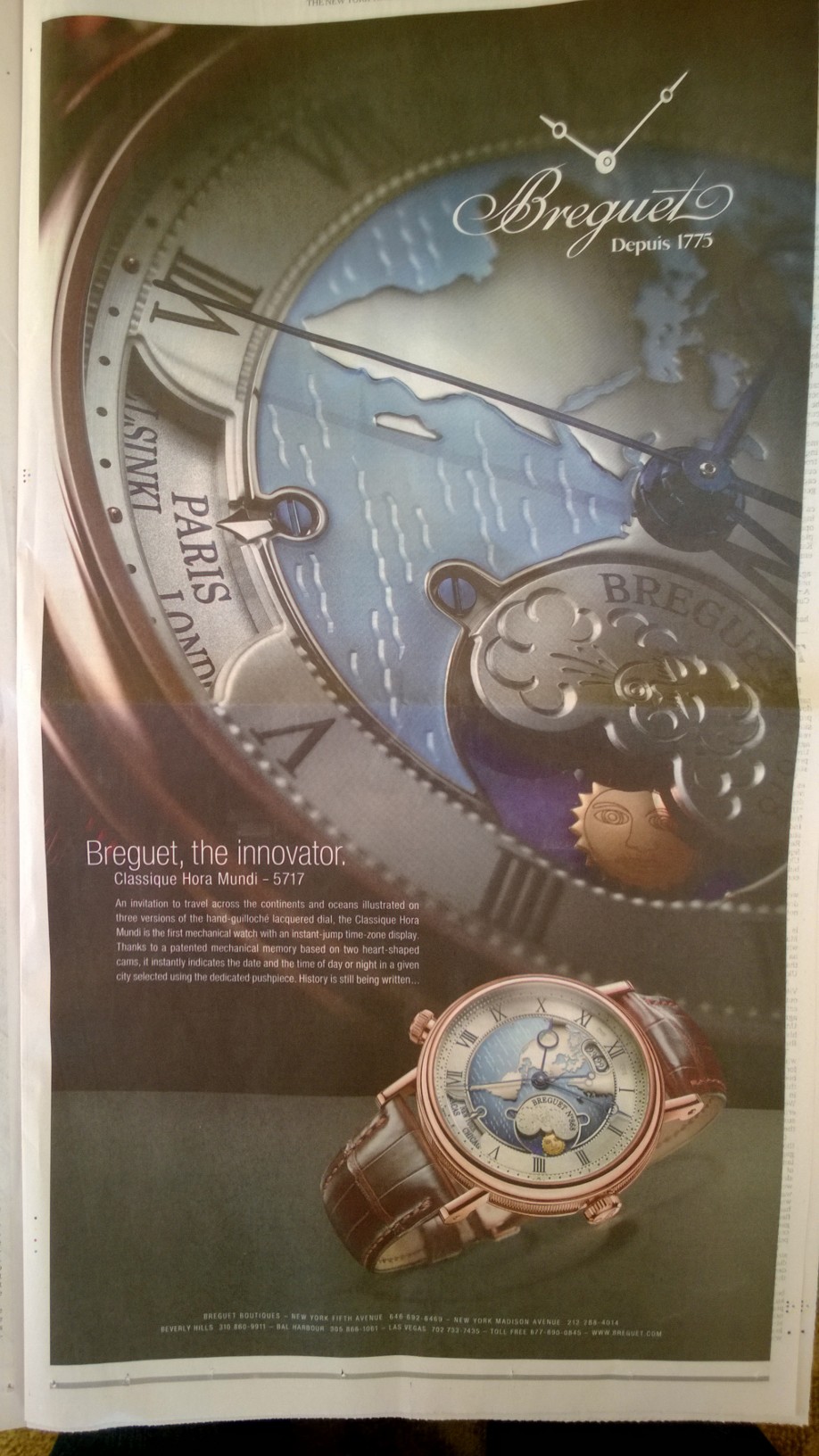
I had never heard of a Breguet watch until thumbing through a lovely glossy magazine published by the brand earlier this year. The booklet paid homage to the Swiss roots of the company, its longevity and amazing craftsmanship – Breguet created the world’s first wristwatch and opened for business before the U.S. declared independence. Inside and out, these timepieces are unlike any others in the world. Rolexes are elegant in their simplicity, Breguet timepieces are elegant in their overt beauty and celebration of complexity.

As the craft economy grows, so will grow the market share of companies like Beguet because they embody the movement (excuse the pun.)  The craft economy, signaled by craft beers, Etsy, workworking channels, etc., has also spawned the latest trend, the maker society.  The word “maker” is the latest pop marketing term and started with the very cool Makerbot. Maketbot is a 3D prototyping printer and was shown in a recent 60 Minutes piece creating a working hand prosthesis for a child…for a few hundred dollars. (The 3D printer is really a robot. The making of robots is cool; mass producing robots – not really craft economy stuff.)

Back to Brequet. When a person holds a “thing” in their hand made by another person and is astonished by the craftsmanship, it is an affirmation of humanness. (I encountered this feeling when as a volunteer archeologist in Maine I found a deer rib bone in the shape of a weaving shuttle, ornamented by human hand. Blown away.) Mass produced products do not astonish. Frankly they lack brand panache and brand story.

The craft economy does not delight customers, its goal is to astonish.   Peace.  

Breaking the ACA logjam.

0

In my blog I try to not be political.  I save that for Twitter. If my political underwear is showing today, forgive me. I have a thought about moving the Affordable Care Act forward…helping insure many of the uninsured, focusing on preventative health care, and lowering overall cost.

It was reported today that the Californian insurance Exchanges are cranking. The especially good news is that the about 1 in 4 new signees are of the age between 18-34: part of the demo that is the healthiest and that will make the economics work better for other age groups.

Here’s the marketing idea.  Target Millennials and make them early adopters. Many Americans have what I call Peter Pan Syndrome and would love to be forever young. Great grandmas on Facebook. Boomers with Fitbits. Xers drinking cold pressed juices.  We follow the younger because they are in tune with what’s next.

If we create a flow of adoption among Millennials ahead of the rest of the market, and they do so for all the right reasons, perception among other age groups will chance.  Especially if they are taking the moral high ground. (Underwear, sorry.) Millennials care more about the planet, they care more about sustainability, on average they are less xenophobic.  Should they lead the way — even at the cost of opening their own smaller pockets — the floodgates will open. They will, they shall, and whoever is marketing these plans should target them. Peace. 

Marketing Quizzes vs. Midterms.

0

No to go all “memory lane” on you, but here’s a story with a moral. When I was an account supervisor at McCann Erickson on AT&T (the technology part, not the voice part), I developed a fact book containing all relevant and import business data — information needed to be conversant in this technical and important piece of business.  Gathering and presenting the data was a great exercise for the AE and AAEs, who were pretty much mushrooms at the time; smart, but not seeing a lot of daylight.  The book’s main purpose was to educate McCann’s president, should he be called to attend a meeting. It could easily be read in the hour it took to drive from NYC to Bridgewater, NJ.   

A story appeared in today’s NY Times suggesting that daily quizzes in college improve student learning when compared to traditional midterm and final testing. My fact book was more like a midterm than a daily quiz…but better than nothing.

Chief level executives at agencies may know their craft (see yesterday’s post), but it’s unlikely they speak the language of the client.  What my fact books did not possess was a section on key consumer and buyer insights. There was a target section, yet only am inch deep.  C-levels who cannot speak the language of the client are simply passing through.  Smart window dressing.  They need more frequent quizzes on the businesses they own, not midterms. Or worse, finals. Finals are when they have to defend and re-pitch the business.  Peace.


Sales Accent.

0

I have long had a pet peeve about the importance of category experience when it comes to hiring.  In advertising and marketing it is very important when hiring candidates to know they have spent time working in the category. My wheelhouse, for instance, is in technology, healthcare, education and beverages. This may not be attractive to a company looking to hire someone with financial background. The logic is that the getting up-to-speed period for a newbie is longer and, perhaps, wasted time.

My view has always been that the categories in which ad and marketing people are expert, are advertising and marketing.  Selling, not manufacturing. I also believe coming to the party with preconceived ideas about a category stifles learning. Candidates may possess biases that are well-founded based upon their last assignment, but not necessarily accurate from the consumer’s point of view.

Where category experience comes in most handy, is in understanding the buying language. If you are trying to sell technology to a school teacher, it’s important to know what they care about. And the language they use when talking about what they care about.  If you use language in ads or marketing that is generic you are leaving cash on the table. You have a sales accent. Good endemic category language is like music to the ears of customers and prospects.  

How do we balance the negative that is “experience bias” with the positive that is finely-tuned “voice and language”?  Very carefully. Peace.


Presenting Strategy

0

I was doing some pro bono brand planning work a couple of years ago in Bedford Stuyvesant on a project called LUG, which stands for Living Urban Green, and learned a valuable lesson.  LUG is a well-intended program, or subprogram, under the auspices of Bailey’s Café, a local community group. Stephanie Siegel and Kymbali Craig are the founders of Baily’s Café.

The LUG meeting was held at Paul Robeson High School and attended by the two founders and number of high schools kids.  I was there to help.  At least that was my intention. The vision for LUG, as explained by the kids was much greater than the name suggested.  Bedford Stuyvesant is a community that does not have a lot of recycling emphasis.  LUG was intended to change that. The words “living urban green” are descriptive and have a nice call-to-action. Part of the mission of LUG, however, was to clean up another element of environmental pollution: cursing, disrespect of women, disrespect of others. I loved this program. The founders loved it and the kids got the mission.

My problem was with the name. Internally we could make LUG mean anything we wanted, but externally, in fund raising, the project would seem recycling focused. I was pushing for narrowing the focus to hit recycling hard or to alter the name to reflect the bigger mission. My high schools students listened politely, but wondered about this interloper. Who is this guy who disagrees with the founders? Ms. Siegel and Craig understood my POV but were watching the kids and got caught up in their body language. (I didn’t see it. These kids were good.)

My branding observation may have been right, but I didn’t work the room very well.  My corporate was showing. Strategy is important but you can’t truly communicate (sell) if you don’t work the room. Moreover, you can’t connect well when people are protective or defensive. Lesson learned. Bad planner. Peace.