
Fear, Uncertainty and Dismal Doubt.

0

FUD (fear, uncertainty and doubt) drove billions of dollars of B2B marketing communications in the 90s and was the brainchild, so I’ve been told, of IBM.   “Nobody ever got fired for buying IBM” was the quiet mantra of IBM sales team and ad agencies.  With proper and subtle brand management, this notion was acculturated into the IT departments across American and beyond.  I’m not aware of any IBM ads ever mentioning FUD.

Digital Equipment may have been the company IBM was trying to scare people from; Apple at that time certainly wasn’t a factor. The strangle hold IBM had on business during that period, thanks to FUD, was broken by Dell when Michael Dell opened up the computer and showed us it was a bunch of simple parts — worth a good deal less than the white shirts at IBM were offering. Plus Dell took advantage of a technological breakthrough – the US Postal Service – to change the game by selling direct to the IT dept. For those old enough to remember, Dell boxes were flying in and out of IT depts. across the country.  It was Christmas every day for techies.  The fear was gone. Fast forward a few years and IBM sells its PC business and does some serious brand retrenchment, tossing “the fear” in favor of a more positive “building good systems” approach. IBM is crazy back.

Strategic planners need to understand fear, but they shouldn’t use it. Leave it to Disney and Comcast and CBS to deliver our required dose of fear. (NBC…Grimm? Really?) Plan strategy using the end-game of hope and deliverance and well-earned reward. Those are things in which it is worth investing. Peace!

Mine the Goodness.

0

A friend of mine recently told me his family has not used a credit card in 8 years.  Sounds as if 8 years ago his family was spending a little beyond its means. Then something happened. Sanity happened.  The same insanity that drove my friend’s family to the brink has infected gov’ts and corporations alike over the past couple of decades and though I suspect the U.S. government hasn’t completely seen the light, businesses are starting to. Certainly families have.

With unemployment creeping in the right direction and markets beginning to slide step forward, my gut tells me this recovery will be tempered in a positive way and we’ll all exercise more restraint. Business owners and families will be much more mindful of expenses.  Expenses will be monitored more closely and the work supporting them will be harder work — smarter work.  Case in point: Vermont.  Always a state known for thriftiness and hard work, Vermont was devastated by hurricane Irene.  Mile and miles of roads and bridges were washed out in late August and the expectation of repair was $1 billion and a year to complete.  Today Vermont is almost completely back to normal road-wise and the price tag looks to be more like $200 million.

How?  The recession made us stronger, smarter, more willing to work together.  Certainly it did in VT.  Now that goodness needs to spread. A goodness born of tough times. Let’s mine that goodness y’all.  Peace!

Two Lessons From One Conversation.

0

I love the Metropolitan Diary column, Mondays in The New York Times.  It provides wonderful stories and insights about the NYC experience and beyond.  Today it also shared a brand planning lesson. With all this marko-babble about “the conversion” in marketing today, here is a real slice of life that takes unlikes and  near-likes and starts a real conversation. Are these people selling? In a sense, yes. Peace!

Dear Diary:

About six weeks ago, I was on a very crowded subway coming home from my school, where I am in ninth grade. I was standing next to a woman wearing a head scarf and a tall man wearing a taqiyah (a Muslim skullcap).

He turned toward her, said, “Salaam alaikum,” and asked where she was from. “Iran,” she replied.

The man said he was from Palestine. Just then, another woman turned around and said, “I’m from Egypt.”

“Wow!” the man said. “We’ve got the whole family here.” They started talking about their jobs and what had brought them to the States.

The man said that he worked for an antidiscrimination organization intended to prevent prejudice against Muslims. He handed the two women leaflets about how to prevent discrimination, and I guess he noticed me watching and listening because he offered me one as well.

“Thank you very much,” I said, “but I’m Jewish.”

“Doesn’t matter,” he responded. “You have the same civil rights as we do.”

I took the leaflet just as the train got to my stop. With a “shalom” and a “salaam alaikum,” we bid each other goodbye.

Sam Mellins                                

“Brand” is No Substitute for “Idea.”

0

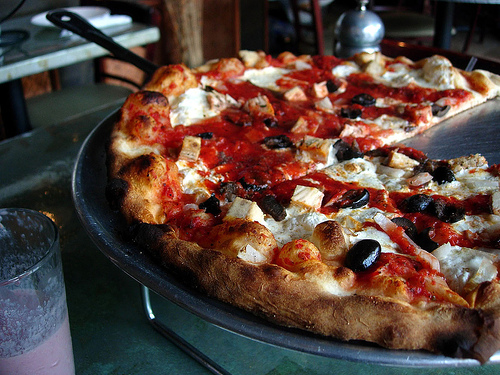
I was just reading an article about Grimaldi’s pizza in Brooklyn (“This is my piz-ah-reeah,” Danny Aiello) and one of the key difference-makers for the stores is their coal-fired ovens.  Sure the ingredients are good, but there is something to be said for 700 degrees of coal-fired, brick oven pizza. An idea.

Papa John’s Pizza, a national chain, also has a brand idea: “Better ingredients.” And a delivery mechanism for the claim: Papa John himself.  Better ingredients is a great place to start — if your ingredients are better. I suspect if the ingredients were better, we’d probably know why. But we don’t. This where brand planning falls down: all claim no proof.  I saw a Papa John’s ad watching NFL football this weekend that showed ingredients that looked like they were shot through cellophane. The commercial was likely shot using a video or low-def video camera.  

Marketers and agencies who use the word “brand” all the time and who don’t fill their conversations with real “claim” and “proof” words are not only a nuisance, they’re a blight.  To wit, Papa John in meetings should never be talking about the brand, but about better ingredients. At the end of the day as he heads to his car he should be saying to himself “What did I do today to make our ingredients better?”  This isn’t meant to be a slam on Mr. John, he actually has a brand idea. (Many marketers just have campaigns.)  He just needs to live it. Peace!

A Marketing Lesson.

0

Not one to throw darts at people I don’t know, I have been known to ding their actions. That’s the fun of blogging.  One marketing person who is a bit of a lightning rod, especially to those in the advertising business is Joel Ewanich, chief marketing officer of General Motors.  Forbes called him “Marketer of the Year” in 2009 and he has done some great marketing putting Hyundai on the map. I’ve written about Hyundai’s smart marketing for years.

But lately, Mr. Ewanich who is nothing of not decisive, has been spending his time shaking up the ad agency roster and tossing grenades. Google “Goodby Silvertein+Ewanich.” While Mr. Ewanich was spending much media time energizing and de-energizing agencies his defining product launch, the Chevy Volt, was going long on glamour and short on engineering. It was reported today that the Volt’s lithium ion battery pack has been found to spark and fire in simulated crashes. 

Marketers, lest we forget, are responsible for product as well as promotion and it seems that the Volt was not adequately tested prior to launch. In all the news about loaner cars and driver safety being job one, I haven’t seen Mr. Ewanich’s name anywhere. Dart time.  Combustion engines go on fire after crashes. Hell, they are filled with gas.  Lithium ion batteries overheat — can you say Dell?  Mr. Ewanich did not design the battery pack or it’s housing, but he is responsible for product readiness.  

A lesson to all marketers: Get the product right first. I understand multi-tasking and readiness, but marketing starts with the product. And ends with the product. Now there’s a marketing trend – product quality. Peace.   

Too much creative, not enough creatives.

0

According to an article in The New York Times “The government says that today 23 percent of fish stocks are not at self-sustaining levels at current fishing pressure.”  That means we are fishing those species into negative territory and they will eventually become extinct.  I wouldn’t be at all surprised to find this same affliction occurring in the advertising business.  

For the sake of this discussion let’s just say there are a limited number of people effective at making terrific, original creative – the type of work that people talk about and that actually motives purchase. The fish.  Let’s say there are 5,000 of these fish.   They may reside at large shops, small shops, digital or be freelancers.  The problem is there are millions and millions of assignments out there. Every day. From a simple Google Adwords text ad to a Super Bowl commercial.  Who is doing that work?  Not the 5,000 fish everybody is trying to land.  Too much work for them. All the other swimmers in the water are doing the work.  Before everything became fair game for advertising messages and everything became media, there were almost enough creative minds to go around.  Today there is not. Creative is being done by anyone with fingers (and I apologize to the digit-challenged population.)   

Add to this the fact that the real fish – the 5,000 – are in such demand that they have no chance to mentor or teach. Not until they are toasted; at which point they are, well, toasted.

So what’s the answer? The web, what else?  And vision. We need to have the fish set aside some time to share what they know with all the other swimmers.  Dave Trott blogs daily and is worth a read. No toast he.  David Droga. David Angelo. Tor Myhren. Please step up. Please take some time to replenish the sea. Use the web. Help the young and those willing to learn. Or the business will slide further into a pond filled with farm raised creators and tasteless pellets.  Peace.

Freehand Messaging.

0

Freehand is defined thusly:

adjective

1. drawn or executed by hand without guiding instruments, measurements, or other aids: a freehand map.

adverb

2. in a freehand manner: to draw freehand.

When CMOs, senior marketers and their agencies say “consumers own brands,” it makes for good copy but bad management. Consumers buy products, weighing in with their pocketbooks as to taste, preference and price requirements, but they do not own the brands.  Ad, direct and digital agencies have known this for years.  It is what creates the conflict between client and agency.  Clients want the work they want and agencies want the work they want.  Clients own the brands.

Freehand messaging is what happens when you turn your brand over to consumers to manage.  The conversation, then, can take any course it wants. Good, bad, indifferent. If I am working my ass off managing a craft cookie brand, around attributes of “naturally moist,” “healthier ingredients” and “complex flavors” — on a shoestring budget — I want to make sure people are talking about those things…the things that sell my cookies. Not cookie ephemera. When the consumer discussion is not guided by brand managers and agencies, the discussion is freehand. And marketers are not doing their job. Every dollar spent by a marketer needs to result in a deposit in the brand bank. Withdrawals are the Antichrist. Stop the freehand by managing it! Peace.

The Marketing Morass that is Google+.

0

“It will change the way people work, share and communicate” is a sentence we’ve heard hundreds of times. And a sentence we’ve read in ads, thousands of times.  This sentence was used in an article today to describe how businesses will use Goggle+ Circles.  According to the same article Google+ is a social network, like Facebook. It kind of looks like a clean version of Facebook but acts more like Twitter, organized to feed information of those one follows.  Then again, it displays pictures and videos in the feed as does Facebook. The buttons and apps in the side margins of Google+ are cool, offering the ability to gerrymander friends and acquaintances into groups and also to do video chats through an exciting feature called hangouts (which I have yet to try), so that feels new — but kind of hidden.

The product managers at Google say Circle and/or Hangouts will change the way people work, share and communicate, and they could be right – but not based on the current mish-mash of free hand messaging in the market today.  Google+ released to techies in Beta because techies thrive on confusion.  They eat it for breakfast. But for the rest of the web Google+ still doesn’t have an Is-Does and so is compared to Twitter and Facebook.  The killer application (video circles) is underutilized and under understood.  I do believe video hangouts or cirlces (or whatever they are) will be a game changer – especially in training and education and problem solving.  But right now the whole Google+ thing is a morass of huh.  Were I Google, Google Labs or BBH, I’d be working on a Super Bowl ad (I know, it’s against their better judgment) that distills the Google+ value and showcases the ease of multiparty video chat to the world.  Google+ was a horrible name. A lazy name for what may be a huge product in 3 years. If properly brand managed. It is still a product in need of an Is-Does.  Peace!