Bracketing Retail Purchases

0

I was shopping with the wifus this weekend and she bought our son two pairs of basketball sneakers for Christmas (He’s not a reader, so don’t worry about the surprise).  She bought him a size 10.5 and an 11. In commercial photography this process is called bracketing; meaning getting two different exposures just to make sure you get the right one.  In retail this bracketing is, apparently, pretty common too.  After the actual gifting, the size (color?) that doesn’t fit is returned.

Doesn’t this reduce selection for the other shoppers, I wondered out loud.  She said everybody does it.  Were I in the retail business I’d frown upon this big time. It encourages returns, reduces the stock availability, and makes lines longer; especially during the holiday. To me this practice seems like a real revenue suck.

Wifus, who may be one of the world’s best, most thoughtful shoppers, disagrees.  “When I come back to return, I’m likely to buy something else.”  Upon prompt she said she probably bought something incremental half the time.  I’m not sold.  Were I a retailer, I’d still stop bracketing immediamente! And I bet it would bottom line positive. You thought? Peace!


Brand Enculturation.

0

I had to look up the word enculturation a couple of months back while writing a pitch email. In fact, at the time I wasn’t sure it was a word.  Enculturation is mission-critical to my business and the goal of every brand plan I write.  A good brand plan helps employees drink the Kool Aid — educating them as to the unique and meaningful points of difference. By enculturating a company with the brand’s promise and supports marketing in its many forms is simplified and made more effective.  Only when a company adopts a brand plan can it truly be extended to consumers. The enculturation of a brand plan organizes employee and consumer minds, removing clutter.

Most advertisers and marketers hate “clutter.” I love it.  The more clutter there is in a category the more likely it can be broken.  A brand strategy may sometimes sound familiar, maybe even undifferentiated, but if it’s the right one, it will be actionable and defensible and its messages, demonstrations, and deeds profound.

Newsday knows where people (on Long Island) live. The Daily News doesn’t. North Shore-LIJ Health System provides a systematized approach to improving healthcare. St. Francis Hospital doesn’t.  Isopure Plus uncovers the taste of pure protein. Milky Ensure doesn’t.

When a brand creates a culture around its points of advantage it becomes a brand. When it doesn’t it remains a product.  Peace!

The Future. G.E. G.M. Healthcare.

0

No dopes G.E.  Jeffrey R. Immelt announced to shareholders Tuesday his strategy to focus on two business sectors: healthcare and energy. By divesting of NBC Entertainment and paring back G.E. Capital, he’s amassing a war chest of $26B for 2010 (I love saying twenty ten) so that G.E. can put some serious Benjamins against Energy 2.0. 

Had Mr. Immelt done this 20 months ago, G.E. would have been in a much better place today but shareholders would have balked and he may have been ousted.  Even if you can see the future, it’s still the future.  The American car industry needed to make a bold move – focusing on more energy efficient gasless cars – 4 years ago but didn’t have the nerve. You just know there were nerds and young engineer types (without vesting) walking the halls of corporate car companies pleading for carbon neutral, low energy cars back then. But the car guys didn’t want to be first to push the plug.  So now we have to wait for the Chevy Volt and when it does arrive, it won’t be available in great numbers. (Mistake.)

The future isn’t going anywhere.  It can be predicted.  Humans and human behavior, short of a mutation or two, are pretty easy to understand. Maslow was right.  What’s holding up healthcare reform right now is capitalism, a touch of greed, and the inability to see the future. It will get done, but there will be bandages along the way.

Joseph Jaffe Kool Aid.

1

joseph jaffe

Joseph Jaffe, founder of Crayon, spoke last night at the Brandhackers Meetup in New York City. He was quite good.  His third book, coming out February 9th with a title having to do with inverting the funnel, is based on the premise that loyalty is the new acquisition which sounds not only smart but profound.  Mr. Jaffe’s current book Join The Conversation is wonderfully named and one he referenced a number of times. What was ironic about the talk, though, was that it was just that — a one-way talk.  There were a couple of shows of hands at the beginning to engage but at no point during the event did we actually engage in conversation.  Where’s the Kool Aid at?

That aside, Mr. Jaffe was very good at demonstrating how the times have indeed changed. He showed a slide of campaigning Barack Obama in Berlin — a fly speck in front of 300,000 or so admirers.  When a close up of the Berlin crowd was shown, Mr. Jaffe pointed out that every person had a camera in hand. Every one. A few had video cameras and one individual was webcasting using a laptop.  Talk about sharing the love? Conversation starters to be sure.

Mr. Jaffe made many good points but the one that resonated the most for me was his summary point #3, “Everything starts with strategy.” What pushed strategy to #3 escapes me, but his notion that campaigns come and go but a “commitment to the brand” (idea) is the way forward sealed the deal.  Read Jaffe.  But better yet, have a conversation with him. Peace!

Mobile. Search. Ads.

0

I grew up watching advertising on television. Part of life.  Direct mail pisses me off due to all the wasted paper and atmospheric warming.  Dinnertime telemarketing annoys me but it’s hard to be mean to humans. Spam in the email box irritates. Telemarketing to my mobile though, oh that one drives me insane.

Google is about to launch a mobile phone handset business, using a Taiwanese manufacturer (“Do no evil” apparently doesn’t extend to domestic job creation) and the exciting, free Android operating system. The phone will not be free and sold “unlocked” — meaning buyers can choose their own compatible (GSM) carriers.  With most cell phones subsidized by carriers in the U.S. it will be hard for Google to make money on the hardware so what’s their play?  The answer is search ads.

 If you think search is big from your chair at work or your couch at home, wait until you see the power of search for those on the go.  People en route are way more likely to want to search for something than people in a chair – and Google knows this, hence the mobile computing effort. Google’s OS is a critical component to mobile search and by owning the phone they keep control. But toes will be stepped on. What sets my hair on fire is the thought that all mobile searches in couple of years will be wrapped in a big fat advertising wrapper. I smell an opportunity.  Peace!

Aol. vs. Yahoo

0

Aol. and Yahoo have both finally figured out that good content begets readership, viewership, referral, and participation which begets — the same.  These two seminal online brands will be dooking it out for years to come. They both took different paths to get here and both have CEOs with unique perspectives, but the battle should be fun to watch. Coke and Pepsi, AT&T and Verizon fun.

Armstrong vs. Bartz

My bet is on Aol. Tim Armstrong hitched his ride to a rising star (Google) and got that success smell on him — but I think he created some of that smell with his focus and good leadership. Carol Bartz’s career advanced by good blocking and tackling and good business decisions, something Yahoo hadn’t had for a while prior to her arrival.  Yahoo made lots of decisions, just not with a solid brand idea driving them. Until proven otherwise, I’ll give Mr. Armstrong the edge and write it off to “derring do.”

Ad dollars are moving online, no doubt, but those in the know will tell you the lion’s share are going to Google thanks to AdWords and their direct-to-consumer, DIY, analytics-powered ad model. As Aol. and Yahoo re-create their online brands and lead the market in the generation of original content (paid and contributed), search will stay a powerful, lucrative utility, but won’t be the best way to find good content. That will be the domain of Aol and, hopefully, Yahoo. Peace!

Kid Healthy Branding.

0

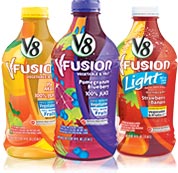
v8 fusion

General Mills and the Campbell Soup Company are doing some really good work to change the poor eating and drinking habits of kids.  General Mills, which already increased the whole grain content in its children’s cereal, has now agreed to reduce sugar in cereals advertised to kids. Campbell’s has created a line of heart healthy sugar and fructose syrup-free V-8 Fusion fruit drinks and marketing them to schools.

Kids love cereal and they love soda and juice, so if the right products are available, affordable and actually taste good, kids will go for them — reducing obesity and diabetes down the road. 

I have always loved the marketing ploy of Campbell’s: one V-8 is like multiple servings of vegetables. That idea carries over to its V-8 Fusion and V-8 Splash drinks. It’s a great, focused branding idea — pregnant with healthy consumer imagery (salt aside).  General Mills is trying to make whole grain a differentiating branding idea, but it’s juggling that with a new effort to reduce sugar.  It’s doing the right thing, but dividing its message to conquer. Were I General Mills, I’d work on the whole grain idea and leave the sugar-free as a side bar.  Sugar free is a bandwagon issue, whole grain is big. Peace!

Publish This!

0

I’ve been talking to a number of people in the publishing business lately — website owners, newspaper strategists, newsweekly VPs, trade publishing executives — and one thing they share is a deer-in-the-headlights gaze. “How are we going to make money?”  “How are we going to stem losses?” “How do we fight off citizen journalism?” 

Let’s face it, there has been a perfect storm of events helping to gut the publishing business.  For me the solution to the storm lies in the very roots of publishing.  People don’t want to search hit or miss for the best news, analysis and entertainment — they want it aggregated, categorized and curated. And they want it from sources with whom they’re in synch.  I read The New York Times because its one place to get what I need.

Publishers do need to worry about paper vs. digital and ad revenue vs. headcount but first they need understand what they do best – what their readers want.  Then they can think about innovation in delivering the content. Too often, they’re thinking innovation first and it is resulting in me-too delivery tactics.  (Can you say Podcast?) Once publishers understand the consumer need they fulfill, the content and content wrappers will emerge. They will stop thinking like newspapers, or magazines, or websites and start thinking like publishers – and the gleam will return to their eyes. Peace!